Years Before the Counter: Inside New York's Sushi Apprenticeship Renaissance
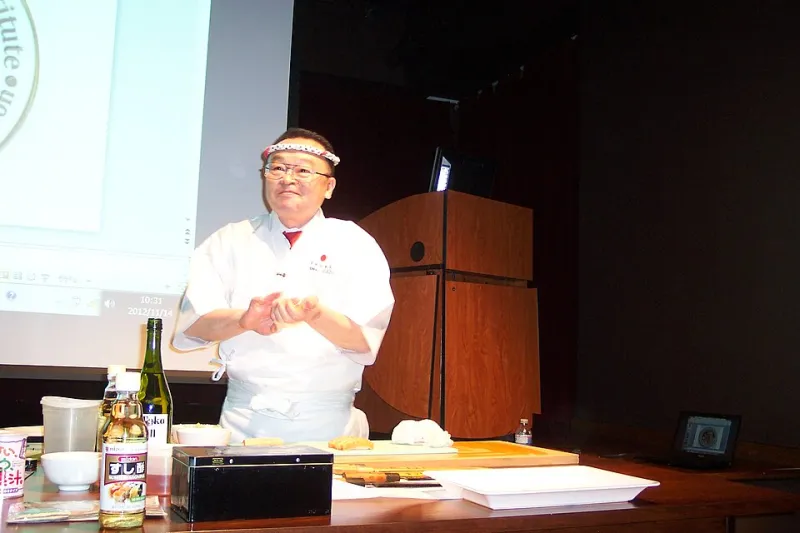
Photo: Geraldshields11, CC BY-SA 3.0, via Wikimedia Commons
There is a particular kind of patience required to stand at a cutting board for three years before you are permitted to touch a piece of fish. It is not the patience of waiting — it is the patience of becoming. In kitchens and prep rooms tucked behind some of New York City's most respected sushi counters, a new generation of chefs is learning this distinction the hard way, and deliberately so.
The apprenticeship model — long the backbone of culinary training in Japan — has found renewed relevance in New York's increasingly serious sushi culture. Where culinary school once promised a fast track to professional kitchens, a growing cohort of aspiring itamae is choosing a slower, more demanding path: years of direct mentorship under a master chef, absorbing technique, philosophy, and professional identity through proximity and repetition rather than curriculum.
What the Dojo Actually Teaches
The word dojo carries a specific connotation in Japanese culture — a place of disciplined practice, where mastery is pursued not as a destination but as a continuous process. Applied to the kitchen, it reframes culinary training entirely. You are not learning to cook. You are learning to see.
In traditional Japanese apprenticeship structures, early years are devoted almost entirely to observation and foundational tasks. Rice preparation — the foundation of all sushi — may occupy a trainee for months before any fish enters the picture. Knife sharpening, often dismissed in Western culinary education as a preliminary skill, becomes a daily meditation. The sharpening of a single yanagiba blade teaches geometry, material science, and the relationship between tool and intention in ways that a weekend workshop cannot replicate.
Chefs who have come up through these arrangements in New York describe the experience in terms that sound less like vocational training and more like immersion in a value system. You learn not only how to break down a fish but why the cut matters — how the angle of a blade affects the texture of flesh, how a clean cut preserves moisture, how respect for the ingredient begins before the guest ever sits down.
The New York Context
New York's sushi scene occupies a unique position globally. It is among the few cities outside Japan where omakase culture has taken deep root, where diners regularly invest significantly per person for a counter experience, and where the sourcing networks — connecting chefs to Tsukiji-adjacent wholesalers, domestic dayboat fishermen, and specialty importers — rival those available in Tokyo itself.
This environment has created both the demand and the infrastructure for serious apprenticeship. Master itamae who relocated to New York decades ago built their reputations on the same principles they absorbed in Japan. As their counters have earned recognition and their clientele has grown more discerning, the question of succession — of who will carry the craft forward — has become pressing.
The informal answer, increasingly, is the apprentice. Not the culinary school graduate who arrives with technical vocabulary and knife kits already purchased, but the young person willing to begin at the absolute beginning, to spend their first months washing rice and their first years listening before speaking.
Structure and Sacrifice
Apprenticeships in New York's sushi world do not follow a single template. Some are highly formalized, with explicit stage progressions and evaluations. Others operate on an unspoken understanding between mentor and student — the master observes readiness and advances the apprentice accordingly, communicating through assignment rather than instruction.
What they share is duration and intensity. Multi-year commitments are standard. The financial reality is often difficult; compensation during early stages may be modest, and the opportunity cost of foregoing higher-paying kitchen work elsewhere is real. Apprentices frequently describe the arrangement as a deliberate act of long-term investment, one that requires a clarity of purpose that the culinary school model does not necessarily demand.
The social dynamics are equally distinct. The relationship between itamae and apprentice carries obligations on both sides. The master is responsible not merely for teaching technique but for modeling the entirety of professional conduct — how one speaks to suppliers, how one addresses guests, how one carries oneself at the counter. The apprentice, in turn, is expected to demonstrate respect through attentiveness and effort, not through declarations of enthusiasm.
Fish Knowledge as a Living Education
Perhaps the most significant gap between formal culinary education and apprenticeship training lies in the area of ingredient knowledge — specifically, the nuanced, ever-shifting understanding of fish that defines exceptional sushi.
Culinary programs can teach students to identify species, discuss seasonality in broad terms, and apply standard butchery techniques. What they cannot easily replicate is the experience of accompanying a mentor to a fish market at four in the morning over the course of several years, developing the tactile and olfactory literacy to assess quality in real time, learning to ask the right questions of suppliers, and absorbing the unwritten knowledge of which fishermen can be trusted and why.
This embodied intelligence — accumulated through thousands of small interactions rather than formal instruction — is precisely what the apprenticeship model is designed to transmit. It is knowledge that lives in the hands and the nose as much as the mind.
The Philosophy That Carries Forward
Beyond technique and ingredient knowledge, those who have trained through dojo-style arrangements in New York speak consistently about something harder to quantify: a philosophy of service and craft that shapes how they approach every aspect of their work.
The Japanese concept of shokunin — often translated as artisan, though the word carries connotations of lifelong dedication and social responsibility that the English term lacks — is frequently invoked. A shokunin does not merely perform a job. They pursue mastery as a form of service to others, subordinating personal expression to the satisfaction of the guest and the integrity of the ingredient.
In a culinary culture that often celebrates the chef as personality, this orientation is countercultural. It is also, for those who have absorbed it through years of mentorship, deeply sustaining. The counter becomes not a stage but a practice — one that, in the best tradition of the dojo, is never fully complete.
For New York diners fortunate enough to sit before a chef shaped by this kind of formation, the difference is perceptible. Not always in any single, identifiable element, but in the overall coherence of the experience — the sense that every detail has been considered, and that the person across the counter has devoted years to earning the right to stand there.