Counterfeit Guests: Inside the Underground Tactics Reshaping Access to NYC's Most Coveted Sushi Seats
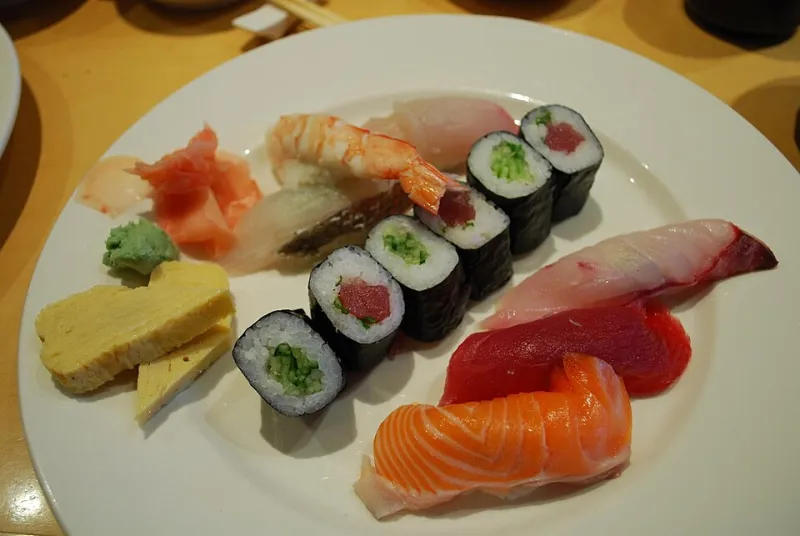
Photo: Alpha from Melbourne, Australia, CC BY-SA 2.0, via Wikimedia Commons
There are only eight seats. The chef has trained for two decades. The fish arrived this morning from Toyosu. And somewhere across the five boroughs, a diner is holding three reservations under three different names — fully intending to honor just one.
This is the current reality at the apex of New York City's omakase dining scene, where scarcity has become so extreme that it has quietly spawned an entire ecosystem of manipulation, strategy, and counterstrategy. The reservation, once a simple administrative formality, has become a battlefield.
The Anatomy of the Modern Booking Hustle
To understand how this dynamic evolved, one must first appreciate what is actually being competed for. New York's most celebrated sushi counters — intimate rooms seating anywhere from six to fourteen guests — release reservations weeks or months in advance through platforms like Tock, Resy, or private waiting lists. When a new date drops, the window for securing a seat can close in under two minutes. For many diners, that window might as well not exist.
The response from determined diners has been inventive, if ethically complicated. Multiple-reservation stacking — booking the same date across several restaurants and deciding later — is perhaps the most common offense. Some diners hold redundant seats at the same restaurant under alternate names or household members' accounts, treating cancellations as a hedge rather than a courtesy. Others have developed coordinated refresh strategies, enlisting friends or family members to monitor booking platforms simultaneously, effectively multiplying their digital presence at the moment reservations go live.
More sophisticated still are those who have mapped the behavioral patterns of specific restaurants — learning, for instance, that a particular counter tends to release cancellations on Tuesday mornings, or that a specific platform's waitlist algorithm favors accounts with longer booking histories. This knowledge circulates through private dining communities, group chats, and subreddit threads dedicated entirely to New York fine dining access.
Then there is the social layer. In a city built on who-you-know, the cultivation of relationships with restaurant staff, publicists, and industry insiders remains perhaps the most reliable path to a coveted seat. Some diners invest deliberately in these relationships — attending industry events, following chefs on social media with genuine engagement, even dining at a chef's less exclusive projects simply to establish familiarity. Whether this constitutes gaming the system or merely understanding how hospitality networks function is a matter of perspective.
The Restaurant's Response
Chefs and restaurateurs have not remained passive in the face of these tactics. The countermeasures now in place at many of New York's premier sushi establishments are, in some cases, remarkably sophisticated.
Credit card holds and non-refundable deposits have become standard practice, imposing real financial consequences for no-shows and last-minute cancellations. Some restaurants have moved away from public booking platforms entirely, maintaining private lists accessible only through direct inquiry — a deliberate friction designed to filter for guests who demonstrate genuine commitment.
Identity verification has quietly entered the equation as well. Several high-profile counters now require guests to present the credit card used for booking upon arrival, effectively neutralizing the fake-name strategy. A small number of establishments have begun cross-referencing new reservations against records of prior no-shows, building informal blacklists that persist across ownership groups and staff networks.
Perhaps the most telling development is the growing use of reservation concierge services — third-party companies that, for a fee, secure bookings on behalf of clients. These services operate in a legal gray area, and their existence has prompted some restaurants to explicitly prohibit resale or transfer of reservations in their booking terms. The fact that such prohibitions are now necessary speaks volumes about how far the competition has escalated.
What Scarcity Reveals About Privilege
It would be convenient to frame this as a simple story of bad actors and righteous restaurateurs, but the reality is considerably more nuanced. The tactics employed by determined diners are, in many cases, rational responses to a system that structurally advantages those with flexibility, resources, and social capital.
A diner who can take a Tuesday lunch on three weeks' notice has an inherent advantage over one who works a rigid schedule and can only dine on weekend evenings. A guest who can absorb a forfeited deposit as a minor inconvenience occupies a fundamentally different relationship with risk than one for whom that same amount represents a meaningful financial consequence. The underground economy of reservation tactics did not emerge in a vacuum — it emerged in response to a market in which demand has catastrophically outpaced supply, and in which the official mechanisms for fair allocation have proven inadequate.
For the chefs at the center of this dynamic, the frustration is both professional and personal. The omakase counter, at its philosophical core, is designed as an intimate exchange — a chef sharing their craft, their sourcing relationships, their seasonal vision with a small group of guests who have chosen, above all other options, to be present in that room on that evening. When a seat is occupied by someone who booked speculatively, or who views the experience primarily as a social credential, something essential in that exchange is diminished.
The Question of Democratization
There is an uncomfortable irony embedded in the broader conversation about access to elite sushi. New York's omakase culture has, in recent years, made genuine efforts to expand its audience — counters in Brooklyn and Queens offering exceptional experiences at more approachable price points, chefs from diverse backgrounds bringing new perspectives to traditional forms, publications and guides (including this one) working to demystify the customs and vocabulary of Japanese fine dining.
And yet the reservation crisis threatens to undermine precisely this democratizing impulse. When access depends not on willingness to pay or genuine interest, but on the sophistication of one's booking strategy and the depth of one's industry connections, the counter becomes something other than what its best practitioners intend it to be.
Some restaurants are experimenting with solutions that attempt to address this tension directly. Walk-in policies that reserve a portion of seats for same-day guests — deliberately inaccessible to advance planners — have been adopted by a handful of counters. Lottery-based reservation systems, modeled loosely on approaches used in the performing arts, are being discussed, if not yet widely implemented.
Discipline at the Door
What the reservation arms race ultimately exposes is a set of values in conflict: the diner's desire for access, the chef's desire for the right audience, and the hospitality industry's foundational commitment to making guests feel genuinely welcome — regardless of how they arrived at the door.
The finest sushi counters in New York City are, at their best, spaces of remarkable discipline and intentionality. The fish is sourced with precision. The rice is prepared with ceremony. The knife work reflects years of dedicated practice. It seems reasonable, perhaps even necessary, that the process of entering those spaces should reflect a comparable seriousness of purpose.
The diners who understand this — who book honestly, cancel promptly, and arrive with genuine curiosity rather than merely a story to tell — are, in the end, the guests that every chef at every counter in this city is quietly hoping to seat. No algorithm required.