New Traditions at the Counter: Seven Ways NYC Sushi Restaurants Are Bridging Japan and New York Without Losing Their Soul
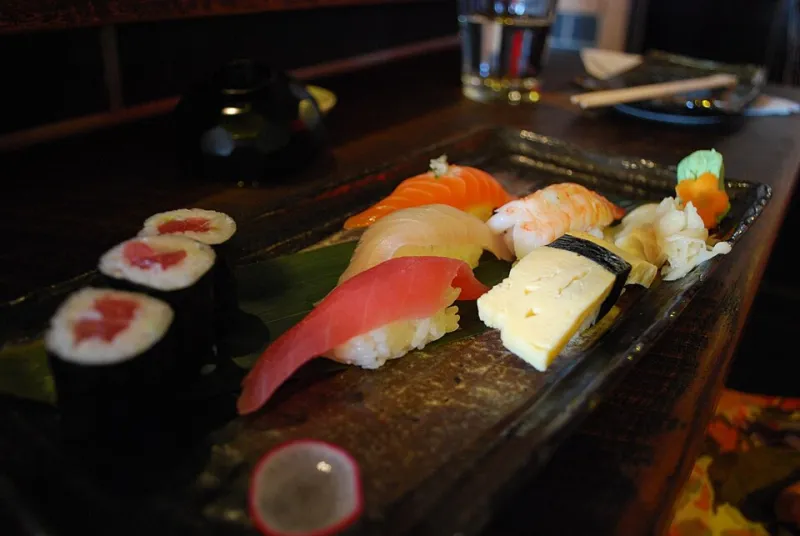
Photo: Alpha from Melbourne, Australia, CC BY-SA 2.0, via Wikimedia Commons
The debate over authenticity in Japanese cuisine has occupied food writers, chefs, and passionate diners for decades. On one side sit the purists, who argue that any deviation from classical Japanese form dilutes the integrity of the art. On the other are the pragmatists, who contend that cuisine has always evolved in response to its surroundings, and that New York City — one of the most culinarily dynamic environments on the planet — demands nothing less than thoughtful adaptation.
At the city's most compelling sushi counters, that debate is quietly being resolved not through argument but through the food itself. What is emerging is a category of dining that resists easy labels: deeply rooted in Japanese tradition, yet unmistakably shaped by the New York context in which it is practiced.
Here are seven of the most significant ways that evolution is happening right now.
1. Aging Programs Tailored to American Flavor Preferences
In Japan, the tradition of aging fish — known broadly as jukusei — has long been practiced to develop umami depth and textural complexity. In New York, several chefs have extended and refined these programs with American palates explicitly in mind.
American diners, chefs note, tend to respond enthusiastically to the rich, almost buttery quality that careful aging produces in fish like striped bass, fluke, and certain cuts of tuna. Where a Japanese guest might appreciate the subtlety of a lightly aged piece, a New York audience often connects more viscerally with the pronounced umami that longer aging develops.
The result is not a lowering of standards but a deliberate calibration — aging programs that push further than traditional Japanese practice while remaining anchored in the same foundational technique.
2. Domestic Sourcing as a Point of Pride
For years, the prestige hierarchy in New York sushi placed Japanese-imported ingredients at the top of every list. That hierarchy has not collapsed, but it has been meaningfully complicated by a generation of chefs who have developed serious sourcing relationships with American fishermen, farmers, and purveyors.
Wild-caught fish from the Pacific Northwest, uni harvested off the California coast, and even locally foraged accompaniments from upstate New York are appearing at counters that would once have sourced exclusively from Japan. These ingredients are presented not as substitutes but as equals — products that reflect the extraordinary natural resources of the American landscape.
For New York diners with an appetite for local provenance, this shift has added a layer of storytelling to the omakase experience that resonates in a distinctly American way.
3. Rethought Portion Architecture
Traditional omakase sequences follow a fairly established rhythm: lighter, more delicate pieces early in the meal, building gradually toward richer, more assertive flavors. That structure remains largely intact at New York counters, but several chefs have adjusted portion size and pacing to accommodate the American tendency toward larger appetites and longer dining durations.
This is not simply a matter of serving more food. It is a structural reconsideration — adding courses, adjusting the ratio of lighter to richer pieces, or incorporating small composed dishes between nigiri sequences — that makes the experience feel more complete to an American diner without dismantling the essential Japanese logic of the progression.
4. Expanded Vegetable Narratives
Japanese cuisine has always accorded vegetables a level of respect that Western cooking has only recently begun to approximate. But in New York, where plant-forward dining has become a serious cultural priority, several sushi restaurants have expanded their vegetable offerings well beyond the traditional tsukemono and sunomono that might accompany a meal in Japan.
Seasonal vegetable preparations — some incorporating Japanese fermentation techniques, others drawing on American ingredients like heirloom squash, ramps, or corn — have become a meaningful part of the dining narrative at forward-thinking counters. These dishes serve as palate interludes and standalone expressions of craft, appealing to the growing segment of New York diners who approach vegetables with the same seriousness they bring to fish.
5. Sake Programs with an Explanatory Dimension
Japan's sake culture is extraordinarily nuanced, and that nuance has historically been difficult to communicate to American diners who lack the context to interpret it. New York's most thoughtful sushi restaurants have responded by building sake programs that are explicitly educational without being condescending.
Tasting notes are written in accessible, evocative language. Sommeliers and chefs take time — sometimes at the counter, sometimes through printed materials — to explain regional styles, production methods, and pairing logic in terms that connect to flavors and experiences familiar to American palates. The goal is not to simplify sake but to give diners the vocabulary to engage with it meaningfully.
6. Reconfigured Counter Dynamics
The traditional sushi counter in Japan is a space governed by a clear, if unspoken, set of social rules. The itamae leads; the diner follows. Conversation, while welcome, tends toward the understated. In New York, where diners often arrive with genuine curiosity and a cultural comfort with direct engagement, several chefs have found ways to open the counter experience without compromising its essential formality.
This might mean a chef who narrates the provenance of each fish with genuine enthusiasm, or a counter layout that allows guests to see more of the preparation process, or a reservation system that pairs guests with chefs whose communication styles are likely to match. The result is a counter experience that feels both authentically Japanese and distinctly New York — unhurried, knowledgeable, and genuinely interactive.
7. Dessert as Cultural Bridge
Traditional Japanese meal conclusions tend toward restraint — a small sweet, perhaps a piece of fruit, a cup of tea. American diners, accustomed to a more emphatic dessert moment, have historically found this conclusion anticlimactic. Several New York sushi restaurants have addressed this gap with considerable creativity.
Japanese pastry techniques — the delicate sweetness of wagashi, the textural possibilities of mochi, the aromatic range of matcha and hojicha — are being deployed in ways that feel conclusive and satisfying to an American palate while remaining grounded in Japanese tradition. These closing courses have become, at some counters, among the most talked-about moments of the entire meal.
What unites all seven of these developments is a quality of genuine respect — for the Japanese tradition from which sushi emerges, and for the New York audience it now serves. The finest counters in this city are not choosing between authenticity and accessibility. They are demonstrating, piece by thoughtful piece, that the two were never truly in conflict.