Dining as Discipline: How New York's Premier Sushi Counters Are Training Guests to Eat with Intention
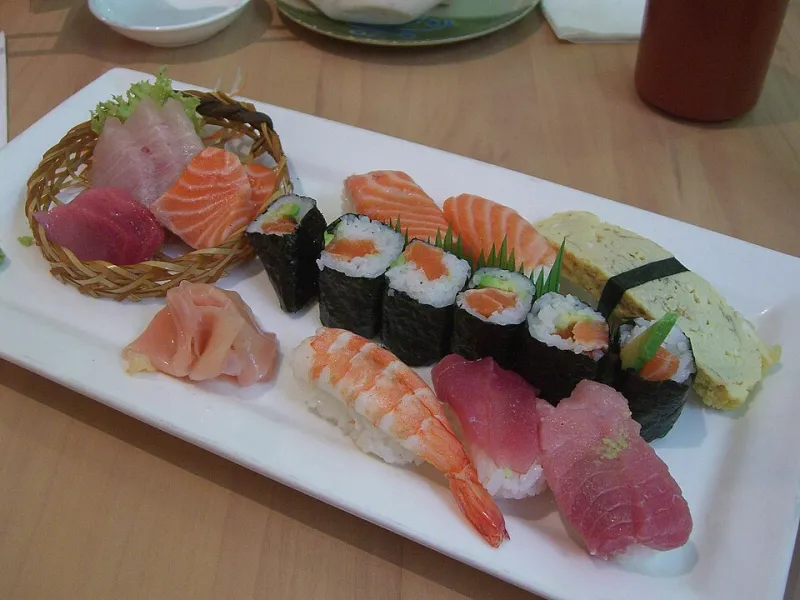
Photo: Alpha from Melbourne, Australia, CC BY-SA 2.0, via Wikimedia Commons
There is a particular moment that many diners at New York's finest sushi counters describe in almost identical terms: somewhere between the third and fifth piece, something shifts. What began as an evening of pleasurable consumption quietly becomes something more deliberate. A chef offers a brief observation—perhaps about the fat content of a particular cut of tuna, or the way the acidity of the shari was calibrated to complement the delicate oils in a slice of yellowtail—and suddenly the guest is no longer simply eating. They are listening. They are tasting with a kind of focused attention they did not arrive with.
This transformation is not accidental. Across the city's most thoughtful omakase and à la carte Japanese establishments, an educational philosophy has taken root—one that treats every seat at the counter as an opportunity to cultivate a more discerning palate. The methodology varies by chef and venue, but the underlying conviction is consistent: a guest who understands what they are eating will appreciate it more deeply, and that appreciation, in turn, honors the craft itself.
The Architecture of a Purposeful Progression
The most immediate tool in this edible education is sequence. At establishments operating at the highest level, the order in which fish is presented is never arbitrary. Chefs typically begin with lighter, cleaner proteins—flounder, sea bream, or young squid—before advancing toward richer, more assertive flavors such as fatty tuna, mackerel, or aged fish. This is not merely a matter of tradition; it is a deliberate strategy for training the palate within the span of a single meal.
By opening with subtlety, the chef establishes a baseline. Guests who might otherwise reach immediately for bold flavors are encouraged, through structure alone, to notice nuance first. When a more complex piece arrives later in the progression, the palate has been primed to register its full dimensionality. The guest, without necessarily being told, has been guided through an exercise in comparative tasting.
Some chefs reinforce this architecture with brief, well-placed commentary. A chef might pause before presenting a piece of kohada—the gizzard shad that is often cited as a benchmark of a sushi chef's skill—to explain that its preparation involved multiple stages of salt and vinegar curing, and that the balance between brine and brightness is the central challenge. That single sentence reframes the next bite entirely. The diner is no longer consuming; they are evaluating.
Real-Time Narration as Pedagogical Tool
The counter format, unique to omakase and certain traditional sushi experiences, creates an intimacy that no other dining configuration quite replicates. Chef and guest occupy the same physical space, separated by little more than a cutting board and a shared reverence for the ingredient between them. This proximity makes conversation not only possible but natural.
New York's most educationally minded sushi chefs have learned to use this proximity with precision. Rather than delivering a rehearsed monologue, the most effective practitioners read their guests and calibrate their commentary accordingly. A table of industry professionals might receive a technical discussion about the specific fishing grounds supplying the evening's bluefin. A couple celebrating an anniversary might simply be told that the piece in front of them is the chef's personal favorite of the season, and why.
In both cases, the information changes the experience. It introduces intention into what might otherwise be passive consumption. The guest begins to ask questions—about sourcing, about aging, about the relationship between rice temperature and fish texture—and in doing so, they begin to think like a chef, if only for the duration of the meal.
The Psychology of Informed Tasting
There is meaningful psychological research supporting what these chefs have arrived at through instinct and practice. When diners are given contextual information about what they are eating—its origin, its preparation, the decisions made in its presentation—they consistently report higher levels of satisfaction, even when the food itself is identical to what uninformed diners receive. Knowledge, it turns out, is a flavor enhancer.
But the chefs who take this philosophy most seriously are not merely optimizing for satisfaction scores. They are engaged in something closer to cultural transmission. Japanese cuisine carries within it a set of values—seasonality, restraint, respect for the ingredient—that are difficult to convey through food alone. Language, even in small doses, bridges the gap. When a chef explains that a particular fish is being served now because it reaches peak fat content in these specific weeks of the year, the guest is receiving not just information but an entire framework for understanding how Japanese culinary culture relates to the natural world.
Restaurants That Embody the Teaching Counter
Across the five boroughs, several establishments have developed particularly well-articulated approaches to guest education. In Manhattan, omakase counters in neighborhoods from the West Village to Midtown have built reputations not only for the quality of their fish but for the quality of their explanations. Guests frequently cite the narrative dimension of their meal as equal in memorability to the food itself.
In Brooklyn, a growing number of Japanese-owned and Japanese-trained restaurants have adopted a slightly more informal version of this approach—one where the educational exchange feels less like instruction and more like conversation. The chef might ask a guest what flavors they noticed in a piece before offering their own interpretation, creating a dialogue rather than a lecture. This model is particularly effective at making guests feel like active participants in their own education rather than passive recipients of expertise.
What unites these varied approaches is a shared rejection of the notion that fine dining should be mysterious or inaccessible. The best sushi counters in New York operate on the conviction that transparency deepens rather than diminishes the experience—that a guest who understands the craft will be moved by it in ways that a guest kept in the dark never quite can be.
What the Diner Takes Home
The lasting effect of this kind of meal is difficult to quantify but easy to recognize. Guests who have been thoughtfully guided through a sushi progression often report that their relationship to Japanese food changes afterward. They begin to notice rice quality at neighborhood spots. They start to consider what season it is when they order fish. They ask questions at the market that they would not have thought to ask before.
This is, in the most meaningful sense, what the best sushi counters in New York are actually selling. Not simply a series of exceptional bites, but a new way of paying attention. The dojo, after all, is not a place where one goes merely to watch a master perform. It is a place where one goes to learn.
The finest sushi counters in this city have understood that distinction for years. The meal ends. The education does not.