From Nervous Guest to Knowing Regular: How a Dojo Mindset Is Changing the Way New Yorkers Experience Sushi
There is a particular kind of dread that attaches itself to first-time omakase diners. It is not the dread of bad food — most people who book a seat at a serious sushi counter have done their research. It is something quieter and more personal: the fear of doing it wrong. Of asking the wrong question, pausing at the wrong moment, or betraying, through some small gesture, that you do not truly belong at the counter.
For years, that anxiety was treated as an unfortunate but inevitable feature of high-end Japanese dining in New York. The formality was part of the experience. The distance between chef and guest was understood as a kind of respect. But something has been shifting — gradually, then all at once — in the way certain restaurants approach the relationship between expertise and access.
The shift has a name, even if most of the chefs driving it would never use it themselves. Call it the dojo effect.
What a Dojo Actually Means
The word dojo traditionally refers to a dedicated space for martial arts training — a room where skill is developed through repetition, failure, and correction, under the guidance of a teacher who has walked the same path. The apprentice is not expected to arrive already knowing. The apprentice is expected to arrive ready to learn.
Applied to the sushi counter, this framing changes everything. The guest is no longer a passive consumer being evaluated by an invisible rubric. The guest becomes a student — curious, attentive, and gradually more capable with each visit. The chef, in turn, becomes something closer to a guide than a performer.
"I do not want someone to sit down and feel like they are being tested," says one Manhattan-based chef who has run an omakase counter for nearly a decade. "I want them to feel like they are beginning something. The first visit is always the hardest. By the third or fourth, you can see it in how they sit — they are present in a completely different way."
That progression — from guarded newcomer to engaged regular — is not accidental. It is, increasingly, something that thoughtful restaurants are designing for.
The Psychology of Low-Stakes Learning
Behavioral research on skill acquisition has long established that people learn most effectively when the cost of error feels manageable. High-stakes environments trigger defensiveness; low-stakes environments invite experimentation. Applied to dining, this means that the guest who feels genuinely welcomed to ask questions, to admit uncertainty, or to simply say I've never tried this before is the guest who leaves with something durable — not just a memory of a meal, but a slightly expanded understanding of what they are eating and why.
Several New York sushi restaurants have begun structuring their counter experiences with this principle in mind, even if the language they use is more intuitive than clinical.
"We always tell first-timers: there are no wrong reactions," says a chef at a Brooklyn omakase counter that has developed a reputation for welcoming guests who are openly new to the format. "If you taste something and you are not sure what you are tasting, say so. That is the beginning of a conversation, not the end of one."
This approach requires a particular kind of confidence from the chef — the willingness to slow down, to explain, to meet a guest where they are rather than where the chef might prefer them to be. It is, in its own way, a form of mastery: the ability to translate deep expertise into accessible language without diminishing either.
Diners Who Came Back
The evidence for the dojo effect is largely anecdotal, but it is consistent. Speak with regulars at any of New York's more deliberately welcoming omakase counters and a pattern emerges: the first visit was uncomfortable, the second was illuminating, and by the third or fourth, something had genuinely changed.
"I went the first time because a colleague insisted," recalls a financial analyst from the Upper West Side who now books omakase roughly once a month. "I understood maybe half of what was happening. But the chef noticed I was paying attention and started narrating — where the fish came from, why the rice was seasoned the way it was. I went home and read for two hours. The next visit was completely different."
This kind of compounding engagement — each visit building on the last — is precisely what the dojo model is designed to produce. Mastery, in any discipline, is not achieved through a single extraordinary experience. It accumulates through repeated, purposeful exposure.
For some diners, the turning point comes not from explanation but from observation. Sitting at an open counter, watching a chef work in real time, communicates things that words cannot. The angle of a cut. The speed of a hand. The deliberate pause before plating. These details, absorbed over multiple visits, gradually form a coherent vocabulary.
How Restaurants Are Building the Environment
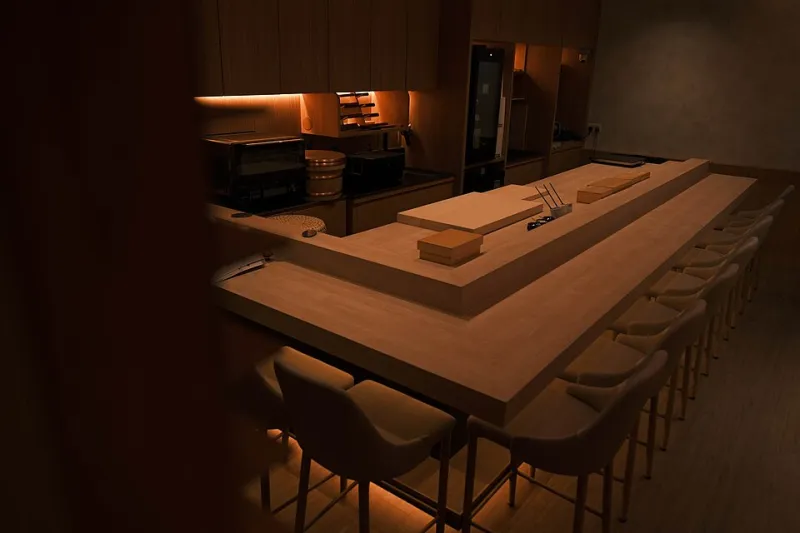
The physical design of a counter matters more than most guests realize. Restaurants that genuinely aspire to the dojo model tend to favor layouts that minimize the sense of theater and maximize the sense of proximity. The chef is not elevated above the guest. The workspace is visible rather than hidden. The atmosphere is attentive without being severe.
Some counters have introduced what might loosely be called orientation moments — a brief exchange at the beginning of a meal in which the chef or a senior staff member invites the guest to share what they already know, what they are curious about, and whether there are ingredients they have never encountered. This is not a quiz. It is an invitation.
"When I know where someone is starting from, I can meet them there," one chef explains. "A guest who has never had uni before needs a different kind of introduction than someone who has been eating it for years. Both deserve the same quality of fish. But the conversation around it should be different."
The commitment to accessibility does not, in any of these cases, come at the expense of rigor. The fish is still sourced with obsessive care. The rice is still treated as a craft in itself. The cuts are still executed with the precision that serious training produces. What changes is the posture of the room — the implicit message that the counter is a place for becoming, not simply a place for arriving already formed.
The Longer Arc
What the dojo effect ultimately produces, over time, is a dining public that is more capable of appreciating what it encounters. The guest who understands why a particular fish is served at a particular temperature, or why the progression of courses moves in the direction it does, is not merely more satisfied — they are more present. And presence, at the sushi counter, is its own form of respect.
New York has always been a city that rewards those willing to put in the work. The sushi counter, at its best, is no different. The dojo is open. The question is simply whether you are ready to take a seat and begin.