What's Behind the Bill: Unpacking the Economics of New York's Escalating Omakase Prices
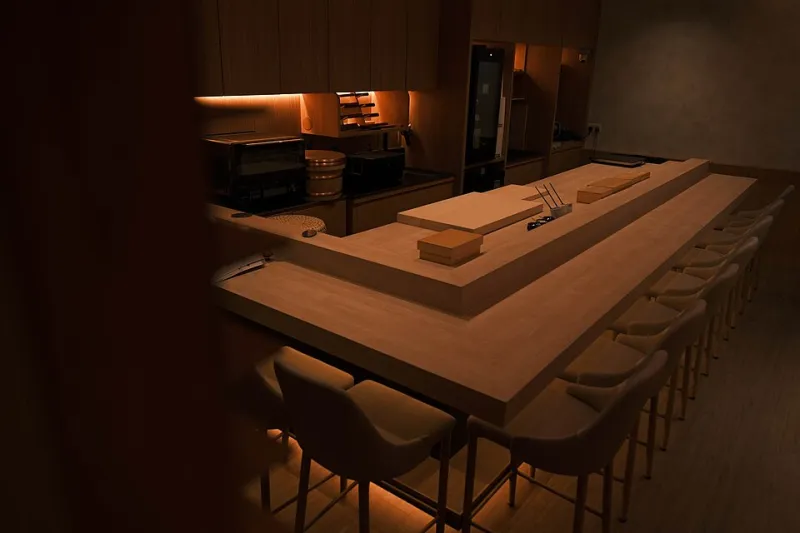
Photo: Bobby.Creations, CC BY 4.0, via Wikimedia Commons
Not long ago, a seat at one of New York City's finest sushi counters could be secured for somewhere between $150 and $200 per person. Today, that same category of experience — intimate, chef-driven, sourced from the same Japanese fishing regions — routinely commands $350, $450, even $600 before tax, gratuity, or a single pour of sake. The numbers have moved with a velocity that surprises even industry veterans.
The question worth sitting with is not simply whether these meals are worth the cost. The more useful question is: what, precisely, are you paying for?
A Convergence of Pressures
The short answer is that omakase pricing does not have a single driver. It is the result of several compounding economic forces arriving at roughly the same time — global supply chain disruptions, a post-pandemic reshuffling of the hospitality labor market, and an accelerating cultural appetite for experiential dining among high-income New Yorkers.
Begin with the fish itself. Premium Japanese seafood — bluefin tuna from Oma or Tsugaru Strait, sea urchin from Hokkaido, live scallops from Aomori — has always been expensive to import. But since 2020, those costs have climbed sharply. International freight rates spiked during the pandemic and have not fully normalized. The yen's fluctuation against the dollar has added another variable: a weakened yen periodically makes Japanese goods cheaper to import, but currency volatility introduces risk that suppliers and importers tend to price into their contracts.
There is also the matter of Toyosu Market, the vast wholesale facility in Tokyo that replaced Tsukiji in 2018. Premium tuna lots at Toyosu have reached historic auction prices in recent years, figures that echo downstream through every restaurant sourcing from Japan. When a single bluefin commands tens of thousands of dollars at auction, the cost per portion at a New York counter is not incidental — it is structural.
The Labor Equation
Fish, however, is only one line item. Labor may be the more consequential one.
The kind of chef capable of executing a twenty-course omakase at the level New Yorkers have come to expect represents years — often a decade or more — of apprenticeship and refinement. That scarcity has a price. Senior sushi chefs in New York are now commanding salaries that rival those in finance and law, with total compensation packages at top establishments exceeding $200,000 annually. Finding qualified sous chefs and prep staff has become equally challenging as the hospitality industry continues to recover from pandemic-era attrition.
One restaurant owner in the West Village, who asked not to be identified by name, put it plainly: "We're not running a restaurant in Tokyo, where the chef may have trained for fifteen years before touching fish and accepts a certain compensation structure. In New York, the market for talent is global and competitive. If I want to keep the person behind my counter, I have to pay accordingly."
That reality filters directly into menu pricing. When labor accounts for thirty to forty percent of operating costs, and those costs rise substantially, the math is unforgiving.
Real Estate as a Luxury Tax
New York City's commercial real estate market adds yet another layer. The intimate counter format that defines omakase — rarely more than ten to fourteen seats — is inherently inefficient from a revenue-per-square-foot perspective. A neighborhood bistro can turn tables twice an evening across fifty covers. A sushi counter serves one seating, sometimes two, for a fraction of that headcount.
In neighborhoods like Tribeca, the West Village, or the Upper East Side — where several of the city's most acclaimed omakase destinations are located — commercial rents have rebounded aggressively since 2022. A twelve-seat counter in a prime Manhattan location may be paying rent that a comparable Tokyo establishment would find extraordinary. That overhead does not disappear; it is distributed across every reservation.
"The counter format is philosophically opposed to volume," noted one food economist consulted for this piece, who studies luxury hospitality markets. "You cannot scale intimacy. So when fixed costs rise, the only lever is the ticket price."
Demand, Prestige, and the Speculation Problem
The supply-side pressures above are real and documentable. But they do not fully account for the degree of price acceleration the market has experienced. Something else is operating here — call it the prestige premium, or more critically, speculative luxury pricing.
Omakase has become a status marker in New York in a way it was not a decade ago. Social media visibility, Michelin recognition, and the broader cultural elevation of Japanese cuisine have created demand that outpaces the number of qualified chefs and available seats. When demand substantially exceeds supply, prices rise not only to cover costs but to ration access — and, in some cases, to signal exclusivity.
This is where the economics become harder to defend. Several industry observers note that not every restaurant raising prices to $400 or above has made proportional investments in sourcing quality, chef development, or the guest experience. Some are, in effect, repricing their existing product to capture what the market will bear.
The distinction matters for diners. A counter that has genuinely elevated its sourcing relationships, hired more experienced staff, and refined its service over five years is a different proposition from one that has simply recalibrated its price point to match competitors and capitalize on the category's prestige.
How to Read a Price Before You Sit Down
For diners trying to navigate this landscape intelligently, a few frameworks are worth considering.
First, transparency is a meaningful signal. Restaurants that articulate where their fish comes from — specific regions, specific purveyors, specific seasons — are demonstrating that sourcing decisions are intentional rather than incidental. A $400 omakase grounded in traceable relationships with Japanese fishing cooperatives is a different investment than one where provenance is vague.
Second, examine the chef's background and tenure. The depth of training behind the counter is one of the few reliable proxies for what you will experience on the plate. Longevity matters: a chef who has spent years developing supplier relationships and refining technique offers something categorically different from a recently opened concept riding the category's momentum.
Third, consider the full cost structure honestly. Tax and gratuity at these price points are not trivial additions — they can push a $350 menu into $500 territory per person. Beverage pairings, if offered, add further. Knowing the all-in cost before booking allows for a more grounded assessment of value.
What the Price Should Represent
At its best, the omakase format asks something meaningful of both parties. The chef commits to years of preparation, to sourcing decisions made weeks before you arrive, to the kind of focused attention that cannot be replicated at scale. The diner commits to presence, to trust, to engaging with each piece as it is intended.
That exchange has always had a price. The question New York's dining public is now confronting is whether the price has grown to reflect the exchange itself — or whether it has begun to reflect something else entirely: the market's willingness to pay for the idea of perfection, regardless of whether perfection is what arrives at the counter.
The most informed diners in this city are learning to ask that question before they book. The best restaurants are the ones that can answer it honestly.