Steel and Soul: The Sacred Bond Between NYC's Sushi Masters and Their Blades
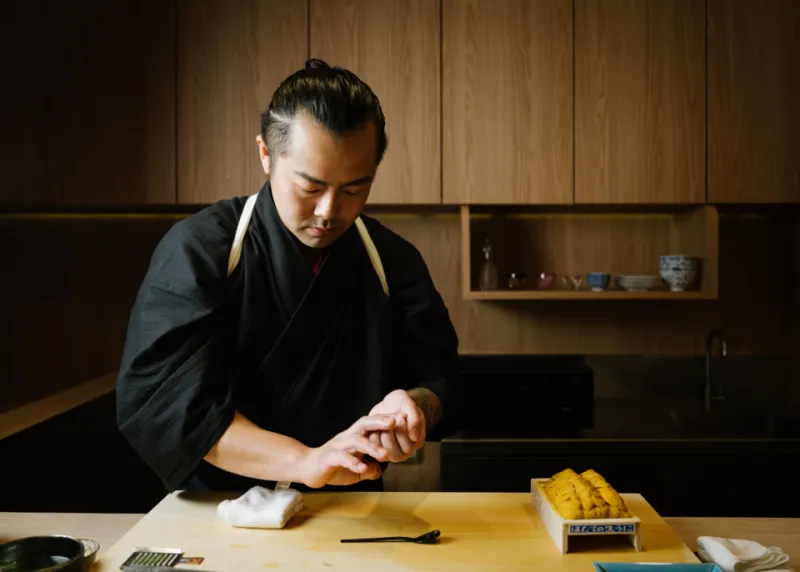
Photo: Bobby.Creations, CC BY 4.0, via Wikimedia Commons
In the spare, deliberate world of high-level sushi, very little is accidental. The temperature of the rice, the angle of a slice, the silence maintained during service — each element reflects a philosophy that prizes precision above all else. Nowhere is that philosophy more tangibly expressed than in the knife resting beside a chef's cutting board.
For New York City's most serious sushi practitioners, the blade is not equipment. It is biography.
A Lineage Forged in Iron
Japanese knife-making is among the oldest living craft traditions in the world, tracing its metallurgical roots to the sword-smiths of feudal Japan. When the Meiji government banned the wearing of swords in 1876, many of those smiths redirected their expertise toward kitchen cutlery. The city of Sakai, in Osaka Prefecture, became the spiritual capital of this transition — and it remains so today, producing blades that account for roughly ninety percent of the professional knives used in Japan's finest kitchens.
That heritage travels well. Walk through the prep areas of several of Manhattan's most respected omakase counters, and you will find knives bearing the marks of Sakai's most celebrated smiths: Yoshikane, Takamura, Mizuno Tanrenjo. These are not brands in any conventional marketing sense. They are lineages — names passed through generations of smiths who have spent entire lifetimes perfecting a single category of blade.
"When I first arrived in New York and began working at a serious counter, my senior chef handed me a yanagiba and told me to treat it as I would a living thing," recalls one itamae who has operated his own omakase room in the West Village for nearly a decade. "I didn't fully understand what he meant until I had sharpened the same knife several hundred times. The blade changes. It responds to how you use it. There is a relationship that develops."
The Anatomy of Choice
The sushi kitchen relies on a specific hierarchy of blades, each suited to a precise task. The yanagiba — literally "willow leaf blade" — is the instrument most closely associated with sashimi and nigiri preparation. Its long, single-bevel edge is designed to draw through fish in a single, uninterrupted stroke, minimizing cellular damage and preserving the integrity of the flesh. A skilled chef can complete a cut with such economy of motion that the fish appears almost to have separated of its own accord.
The deba, by contrast, is a heavier, more assertive tool — a thick-spined blade built for breaking down whole fish, severing bone, and working through the structural architecture of a carcass. Where the yanagiba whispers, the deba commands.
Rounding out the foundational trio is the usuba, a thin, rectangular vegetable knife that demands extraordinary control and is rarely deployed in pure sushi service but remains central to the broader Japanese culinary vocabulary.
Choosing among the dozens of available configurations within each category — blade length, steel type, handle material, single versus double bevel — is a process that serious chefs describe less as shopping and more as courtship.
"I spent three years using borrowed knives before I commissioned my first yanagiba," explains the chef-owner of a celebrated Midtown omakase counter who trained in Kyoto before relocating to New York. "I wanted to understand what I needed before I asked for it. A knife made to your specifications is not something you can return. You have to be ready for it."
Sourcing in the Age of the Global Kitchen
For an earlier generation of Japanese-trained chefs working in New York, acquiring high-quality blades meant either carrying them from Japan or waiting for a trusted colleague to make the trip. Today, the landscape has shifted considerably. A handful of specialized retailers in Manhattan — most notably in the East Village and along the edges of the Japanese culinary supply corridor near the Bowery — now carry serious professional inventory. Online marketplaces have opened access to individual smiths who accept custom commissions from abroad.
Yet many of the city's most discerning practitioners still insist on the pilgrimage. Visiting a smith's workshop in Sakai or Seki, handling unfinished blanks, discussing geometry and steel hardness in person — these are experiences that no digital transaction can replicate.
"Every few years I go back to Japan and I visit the smith who made my primary yanagiba," says one Brooklyn-based chef whose counter has earned consistent recognition from the city's most serious dining critics. "We talk about how the knife has changed, how my technique has changed. Sometimes he makes small adjustments. It is not a transaction. It is a conversation that has been going on for fifteen years."
The Ritual of Maintenance
Ownership of a fine Japanese knife is, in practical terms, a commitment to perpetual stewardship. High-carbon steel — the material preferred by most serious sushi professionals for its ability to take and hold an extraordinarily keen edge — demands consistent attention. It oxidizes readily, requires careful drying after each use, and will develop a patina over time that many chefs regard not as a flaw but as a record of service.
Sharpening is the central maintenance ritual, and it is treated with corresponding gravity. Most accomplished sushi chefs maintain a progression of whetstones — typically moving from a coarser grit for edge restoration to progressively finer stones for refinement and polish. The final passes on a high-grit finishing stone can bring a blade to a degree of sharpness that has no useful analogy in ordinary domestic cooking.
"Sharpening is not a chore," says the West Village chef. "It is the part of the day when you are most honest with yourself about your knife. You feel every imperfection. You feel where you have been careless. It teaches humility."
Many chefs sharpen daily, or at minimum before each service. The process takes time — often thirty minutes or more for a thorough session — and that investment is understood as inseparable from the work itself.
What the Blade Teaches the Diner
For guests seated at a serious omakase counter in New York City, the knife is largely invisible. It does its work behind the hinoki cutting board, in the brief, efficient movements that precede each piece. But understanding something of what that blade represents — the centuries of craft tradition, the individual relationship between chef and tool, the daily practice of maintenance and reflection — transforms the experience of watching a skilled itamae work.
Each piece of nigiri placed before you is not simply the product of good sourcing and practiced technique. It is the result of a relationship between a person and a tool that has been cultivated, in some cases, for decades. The knife that made that cut knows its owner. And in the best rooms in this city, that knowledge is present in every bite.