Unworthy at the Counter: The Quiet Psychological Weight of NYC's Elite Omakase Culture
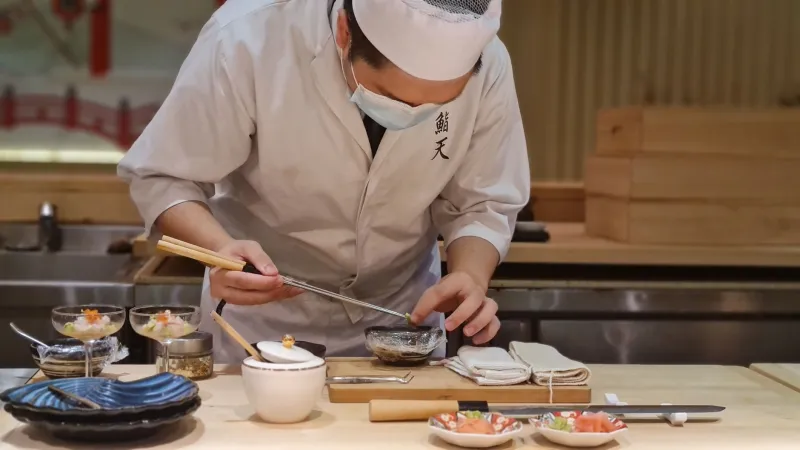
There is a moment that many first-time omakase diners in New York City know intimately, even if they have never named it. The reservation is confirmed. The occasion feels significant. Then, somewhere between the coat check and the first course, a quiet interior voice asks: Do I actually belong here?
It is a question that has very little to do with fish.
New York's high-end sushi culture has evolved into something that extends well beyond culinary experience. At certain counters, the combination of four-figure price tags, months-long waitlists, and an atmosphere of hushed reverence creates a social pressure that many diners absorb without ever articulating. Psychologists have a term for this particular discomfort: imposter syndrome. And while that concept is most often applied to professional settings, it has found a remarkably comfortable home at the sushi counter.
The Architecture of Exclusivity
To understand why elite omakase dining provokes anxiety, it helps to examine what the experience is engineered to communicate. The scarcity is real — many of New York's most celebrated sushi-ya seat fewer than a dozen guests per service. The craft is genuine, representing decades of apprenticeship and sourcing relationships that span continents. The price reflects all of this, and more.
But exclusivity, once it becomes a marketing instrument, has a tendency to metastasize. What begins as an honest reflection of limited capacity and exceptional skill gradually accumulates a layer of social signaling. The restaurant that is genuinely difficult to book becomes, in the cultural imagination, the restaurant that is meant to be difficult to book — a proving ground, a status marker, a test of whether one has the right connections, the right knowledge, or the right net worth to deserve entry.
For diners who clear that bar, the psychological work is not finished. It has, in many ways, only just begun.
What the Price Tag Communicates
Spending three hundred to five hundred dollars on a single meal — a figure that represents a meaningful financial commitment for most Americans, regardless of income — activates a particular kind of self-scrutiny. The question is not simply whether the food justifies the cost. It is whether you justify the cost. Whether your appreciation is sophisticated enough, your palate refined enough, your comportment appropriate enough to honor what is being placed before you.
This is a form of anxiety that the industry has, whether intentionally or not, cultivated. The language surrounding elite omakase dining is saturated with terms that imply hierarchy: mastery, discipline, reverence, transcendence. These are beautiful words. They are also words that position the diner as a supplicant rather than a participant — someone who must prove themselves worthy of an experience, rather than someone who has simply chosen to invest in an exceptional meal.
The result, for many guests, is a kind of performance anxiety that operates in parallel with the meal itself. They monitor their own reactions. They worry about asking the wrong question or failing to identify a fish by sight. They hesitate before reaching for their phone, unsure of the etiquette. They leave the counter uncertain whether they truly appreciated what they experienced, or merely endured it while pretending to.
Manufactured Versus Earned Intimidation
It would be unfair to suggest that all of this anxiety is manufactured. Some of it is an honest response to genuine excellence. Sitting before a chef who has spent fifteen years mastering the precise temperature at which rice must be seasoned, or who can identify the optimal aging window for a particular cut of tuna by touch alone, is legitimately humbling. Reverence for real mastery is not a pathology. It is an appropriate human response.
The problem arises when the theater of exclusivity becomes indistinguishable from the craft itself. When a restaurant's identity is constructed as much around inaccessibility as around the quality of its omakase, the anxiety it produces in guests is no longer a byproduct of excellence. It is, functionally, a feature — a mechanism by which the establishment maintains its mystique and the diner's sense of having achieved something merely by arriving.
This distinction matters. A diner who feels moved to quiet attention by the skill of a chef at work is having a meaningful experience. A diner who feels paralyzed by the fear of appearing unsophisticated has been failed, at least in part, by the hospitality surrounding that craft.
How Some Counters Are Choosing Differently
Not every elite sushi restaurant in New York has made the same choices. A growing number of celebrated chefs and restaurateurs have become deliberate about designing counter experiences that reduce rather than amplify guest anxiety — and in doing so, have arguably deepened the quality of the dining experience itself.
This manifests in small but significant ways. Some chefs narrate their process with genuine warmth rather than ceremonial gravity, inviting questions rather than silently discouraging them. Others have moved away from rigid etiquette frameworks, creating environments where a first-time guest and a seasoned regular are treated with equal consideration. A handful of the city's most respected omakase destinations have begun offering brief pre-service conversations — not as a formality, but as a genuine attempt to calibrate the experience to the guest's familiarity and comfort level.
The underlying philosophy is straightforward: a relaxed diner is a more receptive diner. When guests are not expending cognitive energy managing their own self-consciousness, they are free to actually taste what is in front of them. The meal becomes what it was always meant to be — an act of attention, not an audition.
Reclaiming the Seat
For New Yorkers approaching their first omakase — or returning to a counter after a previous experience that left them feeling vaguely inadequate — there is something worth reframing. The seat at the counter was not bestowed upon you as a judgment of your worthiness. It was reserved by you, for you, in exchange for a commitment of time and money that reflects a genuine desire to engage with one of the world's most demanding culinary traditions.
You do not need to identify every variety of fish. You do not need to have a vocabulary for the precise acidity of the shari or the fat content of the toro. You need only to arrive with an open disposition and a willingness to be present — which is, as it happens, precisely what the finest sushi chefs in this city have always asked of their guests.
The anxiety is understandable. It is also, in most cases, unnecessary. And the restaurants worth returning to are the ones that already know this.