White Belt at the Counter: How Embracing Beginner's Mind Unlocks a Deeper Sushi Experience
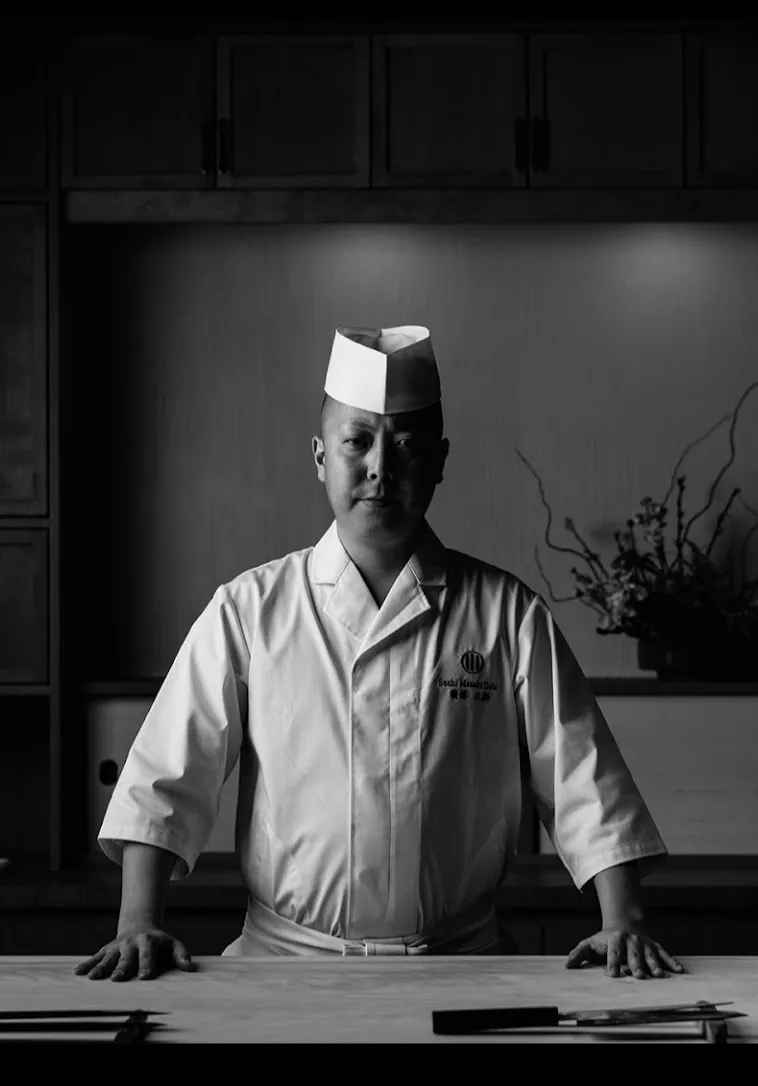
Photo: Sushi Masaki Saito Toronto Canada, Copyrighted free use, via Wikimedia Commons
There is a Japanese concept known as shoshin—beginner's mind—that Zen teacher Shunryu Suzuki once described with characteristic economy: "In the beginner's mind there are many possibilities, but in the expert's mind there are few." It is a principle most often associated with meditation halls and martial arts dojos. Yet anyone who has sat before a skilled sushi chef in New York City and allowed the meal to unfold on its own terms will recognize the same dynamic at work.
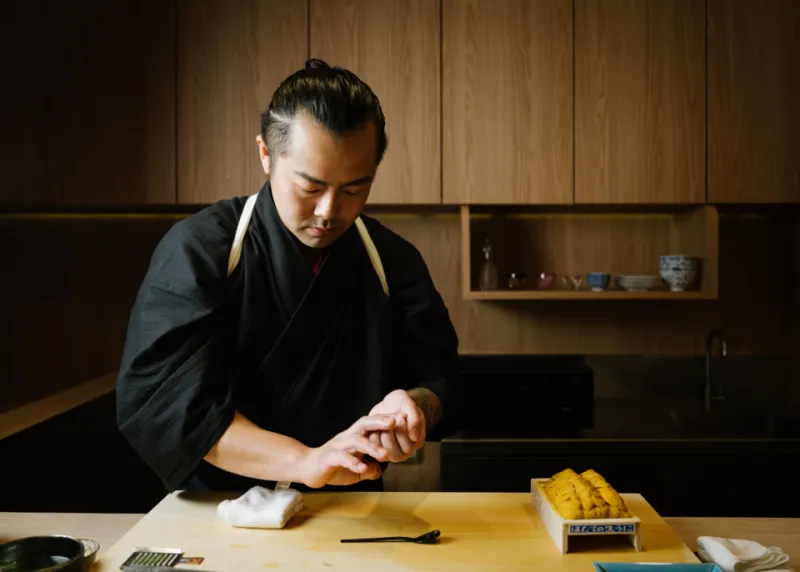
The word dojo translates literally as "place of the way." It is a space devoted not merely to technique, but to the patient, repetitive refinement of perception. The sushi counter, at its best, functions in precisely the same manner—a place where the diner is invited to become a student, and where the most important skill is not knowing what to order, but knowing how to receive.
The Problem with Arriving as an Expert
New York diners are, by nature, discerning. Decades of extraordinary access to global cuisine have cultivated genuine sophistication across the city's dining public. This is largely a virtue. But it can become a liability at the omakase counter, where accumulated preference—a strong attachment to fatty tuna, a reflexive skepticism toward unfamiliar textures, an impatience with the early, leaner courses—can function like a wall between the diner and the experience the chef has constructed.
Consider the martial arts parallel directly. A student who arrives at a dojo convinced that their prior training has already answered the fundamental questions will resist correction. They will impose old patterns onto new instruction. Progress stalls—not because of any deficiency in the teaching, but because the student's certainty has closed off the very receptivity that learning requires.
At an omakase counter in Manhattan, Queens, or Brooklyn, the equivalent behavior is surprisingly common. A guest who fixates on whether a particular piece matches their memory of something exceptional they ate elsewhere is no longer tasting what is in front of them. They are conducting an audit. The chef's intention—the specific temperature of the rice, the deliberate restraint of the seasoning, the arc of the progression from delicate to rich—passes largely unregistered.
Repetition as the Path to Perception
In a traditional dojo, the same kata is practiced hundreds of times not because the movements are complicated, but because the repetition gradually strips away the mechanical and reveals something subtler underneath. The student who performs a technique for the first time is managing their body. The student who performs it for the five hundredth time is beginning to feel it.
The same transformation is available to the committed sushi diner, though it requires a particular kind of intentionality. Visiting the same counter multiple times—across different seasons, with different fish in rotation—is the culinary equivalent of returning to the same kata. What initially registered as a generic white fish course begins, over repeated encounters, to reveal its internal distinctions: the difference between hirame in winter and suzuki in summer, the way a chef's knife work affects mouthfeel, the subtle shift in soy seasoning from one visit to the next.
Several of New York's most respected omakase establishments quietly encourage this kind of longitudinal relationship. Regulars are often served differently than first-time guests—not because the chef plays favorites, but because the chef understands that a returning guest with an open disposition can receive more complex or challenging courses without losing the thread of the meal.
Surrendering the Sequence
One of the most instructive disciplines a new omakase diner can practice is relinquishing control over the progression of the meal. This is harder than it sounds. American dining culture is deeply rooted in individual agency—the menu as a document of personal choice, the server as an instrument of preference fulfillment. Omakase inverts this entirely.
The chef determines what arrives, when it arrives, and in what quantity. The diner's role is not passive, exactly, but it is receptive. This structural surrender mirrors the relationship between a martial arts student and their instructor. The student does not negotiate the curriculum. They trust that the progression has been designed with their development in mind, even when a particular drill feels unglamorous or a lesson seems to contradict prior instruction.
At the counter, this trust is rewarded in specific ways. A chef who senses that a guest is genuinely present—not distracted, not comparing, not rushing—will often extend the experience in small but meaningful ways. An additional piece offered between courses. A brief explanation of why a particular fish was chosen that evening. These moments of connection, which constitute some of the most memorable aspects of omakase dining, are almost exclusively available to guests who have, in a real sense, earned them through attentiveness.
Practical Steps Toward a Dojo Mindset
Adopting a beginner's mind at the sushi counter does not require years of Zen study. It does require a few deliberate adjustments to how one approaches the experience.
Arrive without an agenda. If you are hoping for an abundance of otoro or disappointed when uni does not appear, you have already imposed a script over a meal designed to be unscripted. Release the expectation before you sit down.
Eat in sequence, without skipping. Each piece in an omakase progression is positioned deliberately. The lighter, cleaner courses at the opening are not filler—they are calibrating your palate for what follows. Treating them as such changes everything that comes after.
Notice before you evaluate. Before deciding whether you enjoy a particular piece, spend a moment simply observing it. Temperature. Texture. The ratio of fish to rice. The presence or absence of additional seasoning. This brief pause—a practice any martial artist would recognize as fundamental—shifts the experience from consumption to genuine attention.
Return. The most significant development in any diner's palate does not happen in a single meal, however exceptional. It accumulates across visits, across seasons, across the kind of patient repetition that a dojo demands of every serious student.
What the Counter Teaches
New York is home to some of the most accomplished sushi chefs in the world, many of whom trained for years—sometimes decades—before being permitted to prepare rice for service, let alone stand before a guest. The discipline embedded in that training is visible in every aspect of the meal they produce. It would be a loss to meet that discipline with anything less than genuine curiosity.
The dojo, in any form, is a place of mutual respect. The chef brings years of accumulated craft. The diner brings the willingness to receive it fully. When both parties honor that exchange, the counter becomes something far more than a restaurant table. It becomes, in the truest sense of the word, a place of the way.